Welcome to this week’s UK Marriage
News
Headlines
·
Interfering in-laws are
'responsible for one in 10 divorces' in Britain, study into marriage breakdown
reveals
·
The transforming
power
·
Education before marriage;
marriage before children – the sequence matters
Research
and Public Opinion
·
Interfering in-laws are
'responsible for one in 10 divorces' in Britain, study into marriage breakdown
reveals
Interfering in-laws are responsible for one in 10 marriage breakdowns
in Britain, a new study into divorce has found says
the Daily Mail. Arguments about how often couples see parents and families
were the underlying tensions behind nearly a third of marriage splits, while
rows over how to bring up the children caused difficulties for a quarter of
married couples. Disagreements over the division of household chores, career
aspirations and holidays were also major factors in married couples splitting
up. Meanwhile, half of all married couples never discuss where to live or
whether to have children before they get married, which could lead to trouble
further down the line, the study found.
The study by The Co-operative Legal Services surveyed 2,000 married
couples, including 800 divorcees. While traditional causes of divorce, such as
infidelity and selfishness, were the biggest reasons for marriages breaking
down, lifestyle habits, such as how often they go out and the amount they drink,
and where the couple lives were among the biggest reasons for tension in
marriages.
Christina Blacklaws, Director of Family Law at The Co-operative Legal
Services, said: 'When getting engaged, couples spend so much effort planning for
the wedding day of their dreams that they lose sight of the next 50 years of
married life. Sadly, this is the underlying reason for the majority of divorces,
as couples with different ideas and expectations start to drift apart and no
longer connect a few years down the track. It doesn’t have to be as formal as
pre-marital counselling, but couples certainly stand a much better chance of a
long and happy marriage if they spend time talking to each other about what they
each want out of life and how they want to live their lives together before they
get married.'
A total of 11 per cent of those polled blamed interfering in-laws for
their marriage break down, while eight per cent blamed political beliefs.
Another nine per cent said they got married too young and 13 per cent blamed
their incompatibility. Meanwhile, 31 per cent of those polled said rows over
whether to have children caused tensions, while 25 per cent argued over how to
bring up children.
Top 10
tensions behind marriage splits
1 - Lifestyle choices - drinking etc (46 per cent)
2 - Where to live (37 per cent)
3 - Division of chores (36 per cent)
4 - Whether to have children (31 per cent)
5 - How often to see families (28 per cent)
6 - Being ‘stay at home parent’ or continuing with career (28 per
cent)
7 - How to bring up children (25 per cent)
8 - Career aspirations (23 per cent)
9 - Travelling and holidays (23 per cent)
10 - How often to see friends (22 per cent)
Top 10
reasons for marriage break down
1 - Affair (33 per cent)
2 - Selfishness (22 per cent)
3 - Personality traits (too similar or too different) (14 per
cent)
4 - Abusive relationship (14 per cent)
5 - Different expectations from life (13 per cent)
6 - We’re not compatible (13 per cent)
7 - Job loss or debt (12 per cent)
8 - Interfering in-laws (11 per cent)
9 - Got married too young (9 per cent)
10 - Political beliefs (8 per cent)
·
Men Feel Worse About Themselves
When Female Partners Succeed
Deep down, men may not bask in the glory of their successful wives or
girlfriends says
Science Daily. While this is not true of women, men's subconscious
self-esteem may be bruised when their spouse or girlfriend excels, says a study
published by the American Psychological Association.
It didn't matter if their significant other was an excellent hostess
or intelligent, men were more likely to feel subconsciously worse about
themselves when their female partner succeeded than when she failed, according
to the study published online in the APA Journal of Personality and Social
Psychology. However, women's self-esteem was not affected by their male
partners' successes or failures, according to the research, which looked at
heterosexual Americans and Dutch.
"It makes sense that a man might feel threatened if his girlfriend
outperforms him in something they're doing together, such as trying to lose
weight," said the study's lead author, Kate Ratliff, PhD, of the University of
Florida. "But this research found evidence that men automatically interpret a
partner's success as their own failure, even when they're not in direct
competition"
Men subconsciously felt worse about themselves when they thought
about a time when their female partner thrived in a situation in which they had
failed, according to the findings. The researchers studied 896 people in five
experiments.
In one experiment, 32 couples from the University of Virginia were
given what was described as a "test of problem solving and social intelligence"
and then told that their partner scored either in the top or bottom 12 percent
of all university students. Hearing that their partner scored high or low on the
test did not affect what the researchers called participants' explicit
self-esteem - i.e., how they said they felt.
Participants were also given a test to determine how they felt
subconsciously about their partners' performance, which the researchers called
implicit self-esteem. In this test, a computer tracks how quickly people
associate good and bad words with themselves. For example, participants with
high implicit self-esteem who see the word "me" on a computer screen are more
likely to associate it with words such as "excellent" or "good" rather than
"bad" or "dreadful."
Men who believed that their partner scored in the top 12 percent
demonstrated significantly lower implicit self-esteem than men who believed
their partner scored in the bottom 12 percent. Participants did not receive
information about their own performance.
Findings were similar in two more studies conducted in the
Netherlands. The Netherlands boasts one of the smallest gender gaps in labour,
education and politics, according to the United Nations' Gender Equality Index.
However, like American men, Dutch men who thought about their romantic partner's
success subconsciously felt worse about themselves than men who thought about
their partner's failure, according to both studies. They said they felt fine but
the test of implicit self-esteem revealed otherwise.
In the final two experiments, conducted online, 657 U.S.
participants, 284 of whom were men, were asked to think about a time when their
partner had succeeded or failed. For example, some participants were asked to
think about their partner's social success or failure, such as being a charming
host at a party, or a more intellectual achievement or failure. In one study,
participants were told to think of a time when their partner succeeded or failed
at something at which they had succeeded or failed. When comparing all the
results, the researchers found that it didn't matter if the achievements or
failures were social, intellectual or related to participants' own successes or
failures - men subconsciously still felt worse about themselves when their
partner succeeded than when she failed. However, men's implicit self-esteem took
a bigger hit when they thought about a time when their partner succeeded at
something while they had failed.
Researchers also looked at how relationship satisfaction affected
self-esteem. Women in these experiments reported feeling better about their
relationship when they thought about a time their partner succeeded rather than
a time when their partner failed but men did not.
·
10 Ways Technology Is Ruining Your
Love Life
Technology has completely changed how we live our lives, and it’s
happening at an ever-increasing rate says
an article on listverse. Our worlds are completely different from the world
of even 10 years ago. This obviously has resulted in differences in the way we
work and play, but did you know it’s even changed the way we have sex?
10
Netflix Adultery
A new issue causing strife between couples is “Netflix adultery”:
watching TV shows and movies alone that they promised their partner they would
watch together. Twelve percent of those surveyed said they do it, and 59 percent
of cheaters even reveal spoilers, which means that more than 7 percent of us are
dating huge jerks.
Netflix’s director of public relations Jenny McCabe says that couples
are reporting some serious drama over the phenomenon, commenting “We hear people
say, ‘We made a pact, we were going to watch this together.’ ” It’s a real
violation of trust and lack of consideration that can cause tension every bit as
real as fights over money or other relationship matters.
9
Internet Infidelity
The Internet has made actual infidelity easy and guiltless. Cybersex
offers a convenience and anonymity that can prove too tempting for many to
resist, even if they have someone who is generally willing to have sex with them
right there in the other room. There’s no physical contact, so what’s the
problem? It’s not like cybersex is really cheating, right?
Wrong: 77 percent of people surveyed said that cybersex infidelity is
unacceptable. Despite the many reasons a cheater could use to rationalize their
activities, an overwhelming majority of people agree that cheating is cheating,
period. This new and puzzling grey area is such a big problem that it was
responsible for a full third of divorce cases in 2009.
8 We’re
All Creepy Stalkers
The Internet has given us unprecedented access to the personal lives
of prospective and past partners, and boy are we making use of it. Almost 90
percent of us admit to “stalking” the social networking activities of our
ex-partners, and 60 percent of us admit to doing so to a crush.
This can have catastrophic effects on our well-being, because the
information often doesn’t fully satisfy our curiosity and causes even more
anxiety. Stalking an ex can significantly hamper our recovery from the break-up,
and even spur us to make really bad decisions like hopping back into bed with
them (yes, scientists actually studied this stuff). It might be best to keep
them out of feed, out of mind.
7 Fear
Of Intimacy
Harvard professor Craig Malkin has coined the term “cyber-celibacy”
to describe the increasing number of people who turn to online games and
networks to satisfy their social needs without having to face scary real people.
It creates a vicious cycle, he explains, where people aren’t forced to face
their anxieties about relationships, which makes those anxieties grow and causes
them to retreat further.
How bad is the problem, exactly? Well, 28 percent of people surveyed
admitted that they spend less time with friends in favour of online activities,
and almost as many (20 percent) say they’re having less sex. It turns out that
going outside occasionally is a really important step to taking up residence in
someone else’s underpants.
6
Facebook Provokes Your Jealousy
Following your partner’s Facebook feed creates needless jealousy, one
study says. Even after controlling for other factors (that’s science for
“weeding out the crazy people whose unbridled jealousy would exist either way”),
the study found that the more time you spend reading your partner’s boring
status updates, the more likely you are to turn into a raging psycho.
This happens because a good chunk of your partner’s social
interaction becomes visible to you, but you don’t have those in-person cues that
gives the exchange context. For example, when your lady’s gay co-worker or the
best friend who loves her like a sister leaves an innocent “You look great!” on
her picture, they know it’s a harmless compliment—but all you see is some dude
hitting on your girlfriend.
5 Too
Many Points Of Contact
A lack of communication can be a big problem in a relationship, but
one study suggests that communicating too much can be a strain as well. A survey
of 24,000 married people found that using more than five channels (such as
social media, texting, instant messaging, etc.) to communicate with your partner
actually decreases relationship satisfaction.
The stress of never being more than a series of ones and zeroes away
from your partner and monitoring so many incoming data streams is a killer.
Think about how easy it is to step over that threshold. You follow your
partner’s Facebook and Twitter feed, obviously, and of course they have your
phone number for calling and texting—if you regularly use even one more
communication tool, you’re screwed.
4 The
Online Pornsplosion
With porn so easily accessible, convenient, and increasingly
hardcore, many women are feeling either neglected or pressured to adhere to
male-centric sexual scripts that they don’t enjoy. It turns out that many ladies
don’t actually enjoy being sprayed in the face or poked in the butt (acts that
are simply a matter of course in even mainstream porn nowadays) but feel like
they have to if they want to please their man.
That is, if they’re being asked to please them at all: More women are
reporting that they can’t compete with the blonde, tanned, and augmented video
vixens, and their partners neglect them in favour of pre-recorded thrills. It’s
never a good thing if one person is unhappy with the naked-time routine, but the
problem is so bad that in 2003, it was reported that online porn played a major
role in a quarter of all divorce cases that year (and we’re pretty sure the
amount of porn available hasn’t decreased any since then).
3
Gadgets
Some people are literally addicted to their smartphones; they can’t
even leave the room without carrying them around like a colicky baby. Or maybe
you like to bring your laptop to bed for some late-night work, or even just
watch a little Letterman before tucking in. Well, all of those things could be
wreaking havoc on your sex life, studies show. The mere act of having a phone
nearby is so distracting that we can’t focus on the person we’re with, and
simply having a TV in the bedroom can cut the amount of sex you have in
half.
2
Dubious ‘Matching Algorithms’
Matching algorithms, such as those used by OkCupid and eHarmony, use
questionnaire information about users’ personality and interests, which may help
the strangers find things to talk about, but won’t in any way guarantee
relationship success. Hold on, you say, isn’t it important that my partner likes
Star Wars and skydiving as much as I do? If I end up with a scaredy cat who
hates sci-fi, how are we even supposed to relate to each other?
Actually, the former has little to do with the latter. The way two
individuals interact with each other specifically—i.e., plain ol’ chemistry—is
the best indication of a good match, something that can’t be determined until
two people meet. Maybe that overly cautious person keeps you grounded without
holding you back, or the foreign film nut knows intuitively just what kind of
support you need when you’ve had a bad day. Furthermore, the sites encourage
users to objectify potential partners, “shopping” for matches based on these
superficial and insignificant traits.
1
Googling Your Date
There’s really no such thing as a blind date anymore: 48 percent of
women will not hesitate to Google you before they agree to go out with you, and
just as many are willing to decline if they find unsavoury information. Sure,
some serious bullets can be dodged this way, like if you find your potential
date’s incoherent, violent blog about his serial killer fantasies, but in many
cases, you might be rejecting your soulmate based on a false (or at least
meaningless) representation.
According to one study, the more information we dig up about our
suitors, the more likely we are to reject them. You might think that just saves
everyone some time—you’re going to find out about her online shrine to Hanson
eventually, right?—but before you judge too harshly, take a minute to Google
yourself. Did anything potentially off-putting come up? That embarrassingly
naive op-ed piece about Objectivism you wrote for your college newspaper, say,
or videos of your misguided attempt at hip-hop superstardom? How representative
are those things of you as a person?
The fact is, someone who’s had a chance to get to know all the
virtues and quirks that come packed in the you-shaped bundle is probably going
to find those things endearing, but someone whose first impression of you has
been based on them is going to run away screaming. As study co-author Joanna
Frost, PhD., says, “Your disillusionment with someone during a conversation
might take hours, during which your date has the opportunity to explain himself,
whereas online that disillusionment can happen almost instantly.” So give that
freak a chance to explain herself over a beer—it might just be a charming quirk
in an otherwise flawless package.
·
Is Forever
Feasible?
Despite news reports that marriage is in deep trouble in the U.S.,
Brigham Young University Professor Alan J. Hawkins says that marriage is not
dead says
Huffington Post. In fact, Hawkins believes that even "forever" is feasible
through implementation of a series of affordable, state-run educational
initiatives. That's the premise of his latest book, The Forever Initiative: A
Feasible Public Policy Agenda to Help Couples Form and Sustain Healthy Marriages
and Relationships, along with a step-by-step plan for getting there.
A professor of family life, for decades Hawkins has been researching
and writing about marriage education, the importance of fathers, and government
initiatives to sustain healthy marriages as well as a guidebook for couples on
the brink of divorce.
I've been following Alan's work for a few years now and interviewed
him recently to find out why he's so optimistic about the future of marriage and
his vision for reversing family instability in America.
Q: Why did you write this book?
Alan Hawkins: More than half of first births in our country are to
unmarried couples who will struggle to hold their family together. That - and
divorce - make family instability the most important social problem of our time.
That's saying something given the wide range of social problems that exist
--intergenerational poverty, diminishing educational performance and
opportunities, drug and alcohol addiction, to name a few. Sure, less poverty and
better education and recovery services for addicts will make more fertile ground
for healthy romantic relationships and more stable marriages. But it's equally
true that family instability contributes significantly to poorer outcomes for
children of these unstable unions, not to mention the adults themselves. I think
there are some feasible things we can do to decrease family instability. That's
why I wrote this book.
Q: Marriage is dying off, or at least that's what some people are
saying, haven't you heard? And you're going to facilitate "forever?"
AH: If it's dead, explain why nearly all American youth and young
adults still aspire to a healthy, life-long marriage, why 80-90 percent of all
adults still marry at some time, and about two-thirds of adults age 35-44 are
currently married. The research shows how beneficial good marriages are to
adults, children, and communities. But the work of achieving that life goal has
perhaps never been harder, especially for less advantaged Americans.
Q: So what's your grand plan for fixing marriage and relationships?
AH: Well, I'm not sure how "grand" my plan is; it's pretty basic.
Scholars and therapists know a lot about how to form and sustain healthy
relationships, but we need to get that knowledge out of academia's ivory towers
and clinician's wood-panelled offices to the public, especially to less educated
young people who are at much greater risk for churning, unhealthy romantic
relationships.
Over the past decade lawmakers and policy makers have begun to
experiment with ways to do this. In my book, I document how state and federal
governments have invested nearly $800 million over the past decade in supporting
educational programs, targeted especially to less educated and lower income
individuals, to explore whether these programs can help them form more stable
families.
More…..
·
Marriage beyond
reach
Job insecurity and uncertainty about the future may be a key part of
what’s keeping many working-class Americans from getting or staying married, a
new study suggests reports
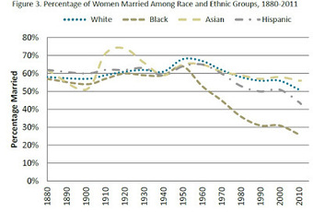
Maybeido. Recent years have seen a big shift in the traditional American
family. According to the U.S. Census Bureau, married couples now account for
fewer than half of all U.S. households — down from 78 percent in 1950. But there
are also clear economic divides. Women with college degrees, for example, are
more likely to get married than women with only high school diplomas — a stark
reversal from years ago.
“It is definitely true that there is a class divide in marriage,”
said Andrew Cherlin, a professor of sociology and public policy at Johns Hopkins
University in Baltimore, who studies trends in marriage and family.
“Working-class adults are postponing marriage and marrying later than they used
to,” Cherlin said. “Marriage also seems to be on the decline as a context for
having children among the working class.”
That’s what’s going on in the big picture. In the new study,
researchers interviewed about 300 Americans — both working- and middle-class —
to get a sense of how economics and education are swaying people’s views on
marriage. They found that, in general, working-class men and women pointed to
job insecurity, low wages and a lack of resources as deterrents to walking down
the aisle. In short, they had a hard time imagining being able to provide for
someone else — financially or emotionally, according to Sarah Corse, one of the
researchers in the study.
“It doesn’t make sense to people to plan for the future if you don’t
even know if you’ll have a paycheck,” said Corse, an associate professor of
sociology at the University of Virginia, in Charlottesville.
The findings, scheduled to be reported at the annual meeting of the
American Sociological Association in New York City, offer some insight into why
marriage is not the draw it used to be — even though most Americans still say
they want to get married at some point. Because this study was presented at a
medical meeting, the data and conclusions should be viewed as preliminary until
published in a peer-reviewed journal.
The decision to take the plunge is not just a personal or moral
issue, Corse said. And for many working-class people, the upsides of marriage
are not as clear: Committing to someone with a low-paying job and a hefty debt,
for example, may not seem like a wise decision. “We need to think about how
income inequality affects other types of inequalities,” Corse said. “It’s harder
to choose to get married, or to sustain a marriage, if you the lack resources
that many educated, middle-class people have.”
Cherlin, who was not involved in the study, agreed. “In our new
economy, working-class young adults often lack the resources to make a long-term
marriage work, so they opt for short-term relationships instead,” he said.
“Marriage plays less of a role in the lives of high-school-educated Americans
than among college-educated Americans.”
In years past, Corse said, Americans without a college education
could still get secure jobs that pay well, in areas like manufacturing. Now, she
said, the opportunities often are in the service industry, where jobs may be
low-paying, only part-time or offer no health insurance or other benefits.
One of the people Corse’s team interviewed was Cindy, a middle-aged
woman who’d spent her whole life in the same small Ohio town. Cindy told the
researchers that when she was a child, her father had a stable manufacturing job
and her family lived comfortably.
But by the time Cindy married, those jobs were largely gone, and her
husband could not find steady work. He eventually deserted her, and she was left
as a single mom with a minimum-wage job at a convenience store. Her daughter,
now 20, never finished high school and lives with Cindy and Cindy’s boyfriend.
Such live-in relationships are more common among working-class and
high-school-educated Americans than those with higher education, Corse said.
“For middle-class people, marriage generally increases stability,” she said “For
the working class, it often doesn’t.”
And that means both financial and emotional stability. “If you can’t
handle your own problems,” Corse said, “how can you take on someone else’s?
Marriage just doesn’t look very appealing.”
For her part, Cindy told the researchers she has no plans to marry
her current boyfriend. (A second marriage ended in divorce after her husband
began to physically abuse both her and her daughter.) Cindy said she still hopes
for a long-term, fulfilling relationship. But, she told the researchers, she is
“not optimistic.”
Overseas
News
·
Tony Abbott offers married couples
voucher for counselling
Tony Abbott, Australia's opposition leader, plans to save and
strengthen the nation's romantic relationships by offering £120 vouchers for
counselling to couples who get engaged and those already married reports
the Telegraph. The vouchers will be offered to married couples for conflict
resolution or parenting classes, while engaged couples could have pre-marital
counselling.
Mr Abbott, a staunch Catholic and the favourite to win Australia’s
election on September 7, is married with three daughters but long believed he
had a “lost son” from a relationship he had while at school and university.
Years later, as a federal minister, Mr Abbott was reunited with the “son”, who
was then aged 27, but DNA testing later showed the child was not his.
The vouchers were reportedly a pet project of Mr Abbott’s Liberal
party colleague, Kevin Andrews, an MP who is a strong proponent of marriage and
last year authored a book called Maybe ’I do’: Modern Marriage and the Pursuit
of Happiness. The book says the biggest threat facing the Western world is not
climate change or radical Islam, but the “continuing breakdown of the essential
structures of civil society — marriage, family and community”.
The Liberal party has proposed to offer about 100,000 “relationship
vouchers“ as part of a one-year trial. The vouchers would be offered to same-sex
couples despite the opposition of both Mr Abbott and his party to gay
marriage.
Mr Abbott, whose sister, Christine Forster, has come out publicly as
a lesbian, has signalled he may allow MPs a conscience vote if a same-sex
marriage bill goes to parliament.
New
Books, Resources and materials
·
The transforming
power
In their new book Gender
and Parenthood, Brad Wilcox and Kathleen Kovner Kline squarely face a
current cultural trend that portrays the father as an optional family figure and
heralds the concept of gender-neutral parenting. Gleaning the results from the
latest research, the authors document the unique role that fathers play in the
lives of their children and the changes in men associated with fatherhood that
equip them to fulfil that role says a review
from Maybeido.
In a recent presentation at The Heritage Foundation, Wilcox, the
director of the National Marriage Project at the University of Virginia,
highlighted the book’s key findings, including the impact that a father’s
presence and involvement has on his children.
In the absence of an engaged father, for example, boys are more
likely to engage in “compensatory” aggressive and predatory behaviour and,
correspondingly, to be delinquent or violent and spend time in prison.
Similarly, girls without paternal involvement are significantly more likely to
be sexually active and become pregnant in their teens. In addition, for both
boys and girls, the “father factor” means a decreased likelihood of suffering
depression.
As Wilcox explains, the impact of fathers can be traced to their
unique input in several arenas. In the realm of play, rough-and-tumble
activities impart lessons to children regarding how to handle their emotions and
bodies—lessons that can extend to social relationships and behaviour. Paternal
interaction also tends to involve an element of challenge, encouraging offspring
to take risks, be open to new experiences, and stand up for themselves. In
addition, fathers tend to exhibit a style of discipline that carries a unique
air of authority and firmness.
Yet the most trailblazing aspect of Gender and Parenthood is the
unveiling of nascent research regarding the physiological psychological/social
effects that fatherhood has on men.
Becoming a father is associated with a decrease in testosterone
levels (associated with aggressive behaviour and heightened libido)—a
development that fosters an instinct to settle down and become domesticated,
preparing the dad for his role in the nurture and guidance of his children.
Moreover, this biological change is accompanied by changes in
behaviour and social relationships and a tendency among fathers to work harder
and to “attend bars less and church more.” In addition, fathers who live with
their children are less likely to be depressed, and the dynamic between the
physiological and psychological/social arenas creates a natural “feedback loop”
that reinforces the benefits of fatherhood.
However, there is no “fatherhood premium” for unmarried fathers. In
Wilcox’s words: “The evidence suggests that fatherhood is most likely to work
its transformative magic on men when they live with their children and the
mother of their children—normally in the married state.”
Sadly, more than one in
five children in America live in homes without dads, and four in 10 are born
outside marriage. To ensure that the next generation has the greatest
opportunity to thrive and succeed, efforts should be made in both the cultural
and policy arenas to promote marriage and intact, healthy families.
Forthcoming
conferences and events
·
Forthcoming
conferences
Details of all forthcoming conferences can always be found under our listing at
2-in-2-1
Consultations
and Campaigns
Below is our running list of current and recent consultations and
campaigns. New items or those requiring action are highlighted. The Reference
numbers are to the newsletter where we covered the subject.
·
Faithfulness Matters
The Faithfulness Matters
Campaign has been launched to ‘challenge companies who run websites which
specifically encourage people who are married or in committed relationships to
have affairs'.
To find out more and see
how you can support the campaign, please visit the website
here.
·
CARE
campaign for recognising marriage in the tax system
In June 2010 David Cameron posed the
question: ‘why do we not recognise marriage?' The policy of doing so through the
tax system ultimately became a major Conservative pledge at the last General
Election and made its way into the Coalition Agreement. However the Government
has still not taken action and if nothing is done before the March 2013 Budget
time may run out for them to do so.
Over a number of years,
CARE has called on the Government to
recognise the benefit of marriage for spouses, children, the wider family and
society as a whole, and to
redress the current unfairness of a tax system which does not take into account
marriage commitment and family responsibility.
·
Manifesto for Children, Young People and
Families
Children England has launched a new manifesto writing process ahead
of the 2015 general election. The manifesto, which will be written
collaboratively with the members, will focus on the following key areas:
Overarching (covering cross-cutting issues such as childhood, poverty, rights);
Schools; Health; Families and family life; Early years; Youth; Justice; Special
Educational Needs and Disabilities; Looked after children; Benefits and housing;
Refugees and Migrants.
To find out more visit the Manifesto
webpage to get involved.
·
Tax breaks for “working family”
childcare
The Government has launched a
consultation on proposals which would provide significant tax breaks to all
working families apart from one-earner couple families. Our tax system already
gives families where one spouse stays at home a particularly difficult time. For
those concerned at the way the new child care proposals exclude one-earner
couple families, this consultation is a great opportunity to make your views
clear to the Government.
Closes 14th October 2013.
Soap
Box!!
·
Education before marriage;
marriage before children – the sequence matters
We did Marriage Prep for another couple last week – another happy
relaxed evening chatting with two people, obviously in love, with dreams of a
lifetime together. Yet in their responses we could see how much they HADN’T
talked about – and seeing the report this week on the reasons couples give for
marriage breakdown and divorce it reminds me how preventable so much of the
misery is!
Take the reasons cited for
splitting: Lifestyle choices; Where to live; Division of chores; Whether to have
children; How often to see families; Being ‘stay at home parent’ or continuing
with career; How to bring up children; Career aspirations; Travelling and
holidays; and How often to see friends. Every single one of these can be
discussed and identified in advance!! Even if specific answers or solutions
aren’t arrived at, at least good practice of how to have a constructive
conversation can be modelled with solid examples of how to reach a principled
decision that respects the aspirations of both partners and seeks a balanced
“win-win” outcome.
So did we cover most of these areas – well yes…. to an extent, after
all we only had one evening! So the couple will be OK?? Well maybe – but I am by
no means certain! And for two reasons. Firstly there are real challenges in
having a constructive conversation in these areas – it requires a level of
emotional intelligence to separate the strong feelings that may arise from the
issue itself, and a skill to communicate without hurting or lashing out. In the
case of our couple there was little evidence of such skills. It would take time,
and more intensive intervention, to really equip them.
But there was another bigger reason for my doubts – the couple have a
one year old child.
Over the years we reckon that about 5% of the couples with whom we do
Marriage Prep subsequently take the decision NOT to marry. We consider that a
success – 5% of couples who have realised that they may just be getting it
wrong, and who then have the courage to change direction.
So what to do here? Do we help the couple realise the number of
barriers to their long term stability and happiness, and risk them deciding to
part their ways – and if so, what are the implications for their child?
The real sadness to us from the list of reasons why couples split is
that it is so eminently preventable… but only if couples do things in the right
order. If people gather the right information about their potential life
partner, if they equip themselves with the skills to have the conversations to
find constructive decisions, and if they reach the commitment to build a
lifetime together before they create a new life whose whole lifetime will be
influenced by their decisions then there is real hope. If not, then they will
lock themselves in with constraints such as children which reduce the freedom to
reach the best outcome for each of them.
Unless and until we can change the attitude to having children
towards one that takes real responsibility for ensuring they have the love and
support of the two parents that brought them into the world much of what we do
will be in vain.
Education before marriage; marriage before children – the sequence
matters.
Best
wishes,
The 2-in-2-1 Team
Technical
Stuff
Keep us informed - Do keep us
posted on your news, and in particular please let us know details of your
project(s), either present or planned.
Either post it at the forum, or
e-mail us and we'll put it
out there for you.
Subscribe
- If
this email has been passed on to you by a friend, you can request your own copy
by replying to this email with 'subscribe' in the subject line and your name in
the body of the email and we will then send further information about the UK
Marriage News and access to the Forums to the address you reply
with.
Unsubscribe
- If
you have received this message in error, or do not wish to be contacted by
2-in-2-1 using email in the future, please simply reply to this message with
'unsubscribe' on the subject line of your reply.
Contribute to
costs – Although we don’t charge for the newsletter, we do invite you to
contribute to our costs. You can do so online or by
sending a cheque made payable to 2-in-2-1 Ltd to 11 Lamborne Close, Sandhurst,
Berks, GU47 8JL.
Change of
Address – If you change e-mail address please let us know! We automatically
delete addresses after two weeks of unsuccessful delivery attempts. Simply reply
to the Newsletter using your new address with the words change of address in the
subject line and we will update your records accordingly.
Access the forums - To start using the system for
the first time simply go to http://www.2-in-2-1.co.uk/forums/.
Scroll to the bottom of the page where you will see a Login box. Put in your
username and password as above and then press the Log in button. You will only
need to do this login the first time you visit - from then on the system will
recognise you each time you return (unless you use a different
computer).
This
Newsletter is published by 2-in-2-1 Ltd, Company No. 3792423 Registered office:- 11 Lamborne
Close, Sandhurst, Berks, GU47 8JL, © 2013. All rights
reserved.














 Another story brought to us by Lynda.